
Vigil Primer - Entry Level Fleet Ship

One of Ribbit. FCs, Shen Xue, took the time to write this lovely primer about the Vigil, our go-to recommendation for new players who are unsure what to bring when supporting a bigger fleet, while their skill points are not allowing them to fly "proper" ships. As you will quickly learn, this little 2M ISK wonder can make quite a difference! Let's get to it.
The Numbers

This is a graph of the DPS of an Apocalypse battleship, a staple of current FW battlefield metagame, against an enemy logistics cruiser, a fairly difficult target for them to hit due to the small signature radius of that ship type. This is absent of any external factors like weapon disruption, and at a fairly favorable range for the Apocalypse. The damage is pretty low compared to the “on-paper” DPS, which can make breaking an enemy logistics wing very challenging.
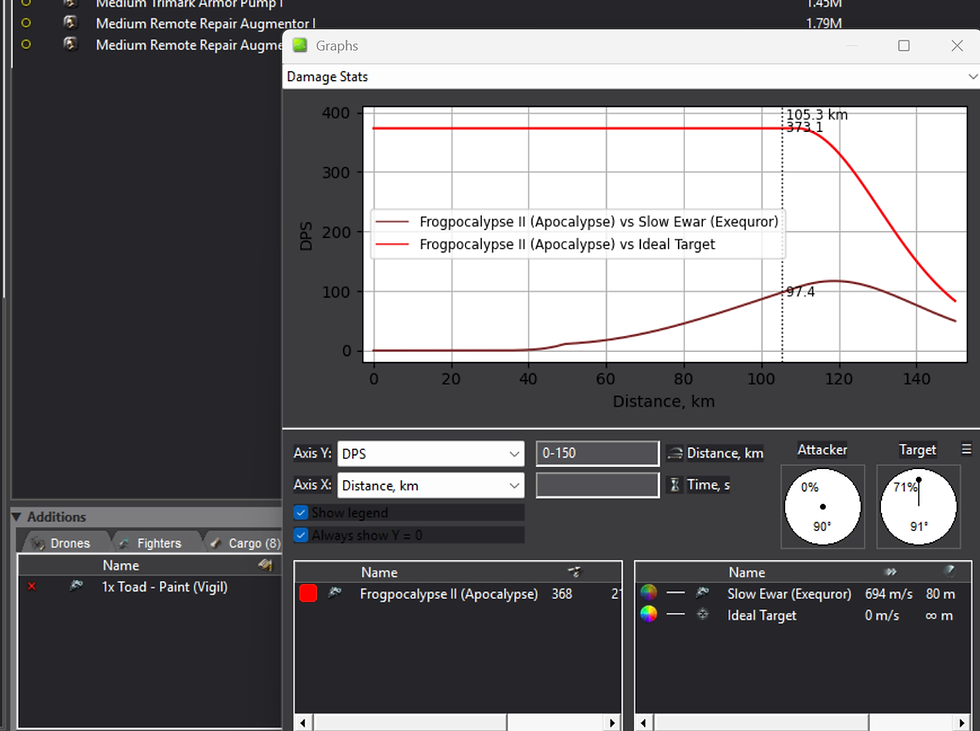
Now here’s the graph with a single tadpole Vigil applying its 3 Target Painters to the target. You’ll notice that the DPS has tripled.

I could end the whole article right there! This unassuming frigate is granting the fleet a 300% damage bonus against a vital target. But for learning’s sake let’s outline what the Vigil does, why it’s effective, and how you can massively contribute to a fleet’s firepower for under 2 million ISK.
About Target Painting
Target Painters (TPs) are a unique E-war module that increase the Signature Radius of the affected ship. In brief, Signature Radius determines the size of the ship, and is one of the stats that make it hard for battleship-sized guns to hit small ships like frigates or cruisers. A single, unbonused target painter can help with damage application a little bit, but a full rack of three TPs on a ship with bonuses like the Vigil can make a ship behave as it was three classes bigger than it is. That means battleship-grade guns can apply their full DPS to targets that are normally difficult to hit, as illustrated in the graph(s) above.
How to Fly
So, your job as a Vigil pilot in a large fleet is pretty simple: follow the FC’s broadcasts for targets, and make sure your TPs are activated on the current primary. Your capacitor is stable and your single light drone is basically an afterthought, so just focus on keeping your TPs activated on the fleet’s main focus. Don’t worry about range too much, as your TPs still work even past their range + falloff, just at slightly reduced effectiveness. If you happen to have more Vigils in your fleet you can divide your works so that one guy keeps all the paints on the primary target, while the other splits their modules between the primary and secondary targets - signature radius also affects how fast a target lock is acquired, so painting the next target makes it easier for the main fleet to switch to their next victim!
That said, before you undock a Vigil there’s a bit of prep work to be done. Skill-wise there’s not too much to worry about, as long as you have Minmatar Frigate at or above III. IV is better an V is obviously ideal, but not essential. Thanks to the range bonus being part of the racial frigate skill, the e-war support skills are useful but not required. Long Distance Jamming and Frequency Modulation increase range and falloff, while Signature Focusing directly improves effectiveness. If you’re interested in flying a lot of e-war ships it behooves you to train these to IV, but if you’re just a sometimes-enjoyer you can leave them at III or less.
More pertinent to consider before undocking is the selection of mid slots. Our Vigil fit is set up to support two options: Microwarpdrive + battery (for cap stability) and afterburner + sensor booster (for extended range).
Which one you choose will depend on the rest of the fleet: for slow projection doctrines like Prophecies or Apocalypses, the afterburner and sensor booster are ideal to match the range of the DPS ships. For kitey ships like beam Omen Navy Issues, the MWD will let you keep up with the gang as they kite around. If in doubt just ask your FC which fit they’d prefer.
Not much to say about undocking and transit. Just the usual - follow the FC’s orders to align and take fleet warps as normal.
Once you do arrive at a combat site, there’s a couple things to do. Generally you should be anchoring on the DPS anchor like any other ship - but you’ll often be significantly faster than said anchor. You also wanna stretch your very limited EHP as far as possible. Therefore instead of doing a Keep At Range on the anchor as usual, you should instead Orbit the anchor at 10-15km. Choose whichever distance keeps your speed as high as possible - if you’re slowing down then increase the orbit radius. You may have to manually pilot on occasion if your orbit takes you too close to a hazard like an enemy ship or NPC.
Keep in mind that flying a Vigil is perfect training opportunity for manual piloting and keeping space between you and your opponents - as long as they are within your lock range, the TPs will do their job so use that to build your in-game piloting skills.
If you do ever find yourself under attack, your priority is to warp out. As soon as you see enemy red boxes (or start taking damage), pick a close warp out and exit the field. After you’re out, do your best to come back in and continue to provide support. If you do die then re-ship into a fresh Vigil and rejoin the fight. I’ll be frank: you’re in a fragile ship and are likely to die often. But at 2m per death it’s not hard to afford replacements, and your service is invaluable to the fleet.
The only major thing left to mention is that stacking penalties place a hard limit of 2 Vigils being effective on the same target. In practice this means a fleet never needs more than 3 Vigils, and the 3rd Vigil is mostly insurance in case the first and/or second ones die.
That should cover many of the basics of Vigil piloting. Happy painting! Original guide cleaned up to remove context specific to our alliance. Full credit goes to Shen Xue.

Comments